






Develop together. Share knowledge.
 Discuss collaboration
Our commitment: empowering your team to work independently
solidforms is not simply an extended development team responsible for producing every individual form variant indefinitely. We establish the technical foundation, share standards and support demanding tasks – from SAP® form development with Adobe Forms to quality assurance. Your in-house developers – and, where appropriate, the developers of your SAP® consulting partner – are involved from the outset.
Our goal is not to develop every form ourselves. Our goal is to enable your company to develop and maintain forms efficiently and independently over the long term.
To achieve this, we rely on clear responsibilities, a consistent forms framework, solidFormKit for centralized forms maintenance and structured knowledge transfer.
1. Get involved early: architecture before form development
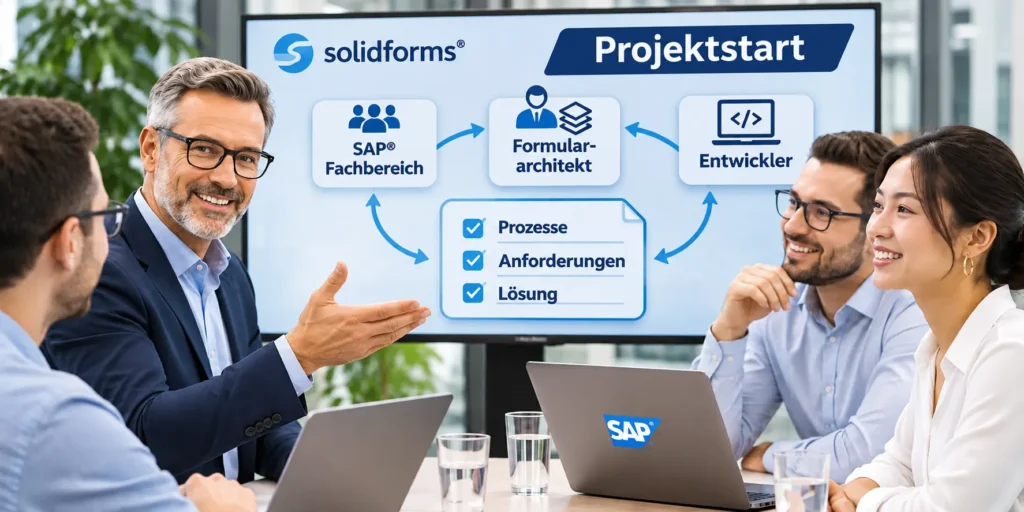
We aim to become involved in SAP® implementation, migration and rollout projects as early as possible. Our SAP® consulting and workshops help align requirements and architectural decisions at an early stage. Many of the decisions that determine whether forms will remain maintainable are made during configuration and process design – long before the first Adobe form is created.
- Which documents are required for which business processes?
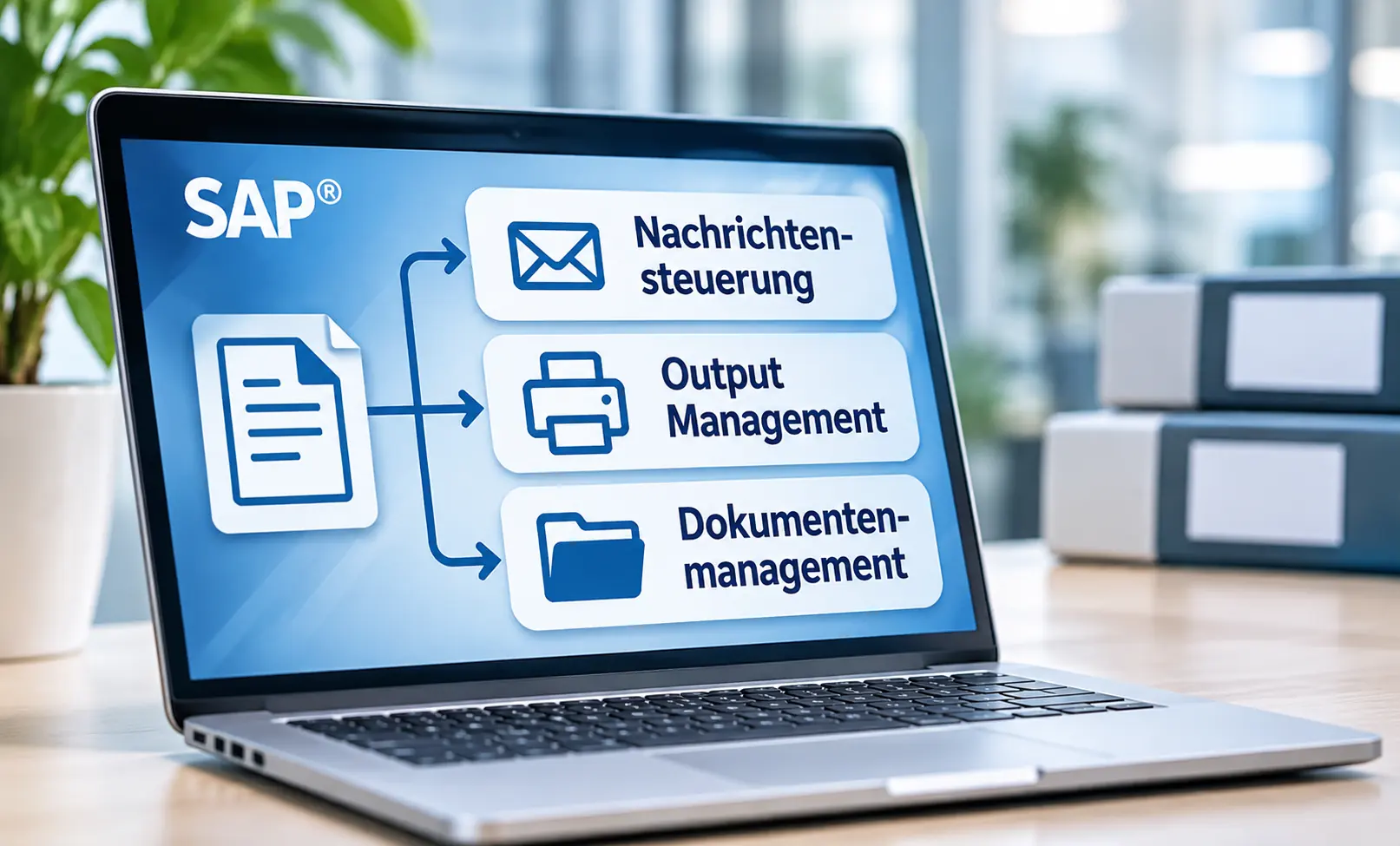
- When and through which events are documents printed, emailed or archived?
- Which company codes, countries, languages and output channels must be considered?
- Which data and control parameters must be provided through SAP® configuration?
- Where do shared templates make sense – and where are separate forms easier to maintain?
This helps us avoid unnecessary custom development and establishes a foundation that makes future changes easier to implement.
2. Practical example: decoupling SAP® pricing from forms
A typical example is pricing in SAP® SD. When a print program accesses individual condition types directly, changes to the pricing procedure can repeatedly trigger development work.
Without a coordinated architecture
The form reads specific condition types individually. When new conditions are introduced or existing ones change, data retrieval and form logic may need to be modified.
With agreed subtotals
At an early stage, we work with the pricing specialists to define stable, business-relevant subtotal levels in the pricing procedure. The form then uses these agreed subtotal values instead of accessing numerous individual condition types.
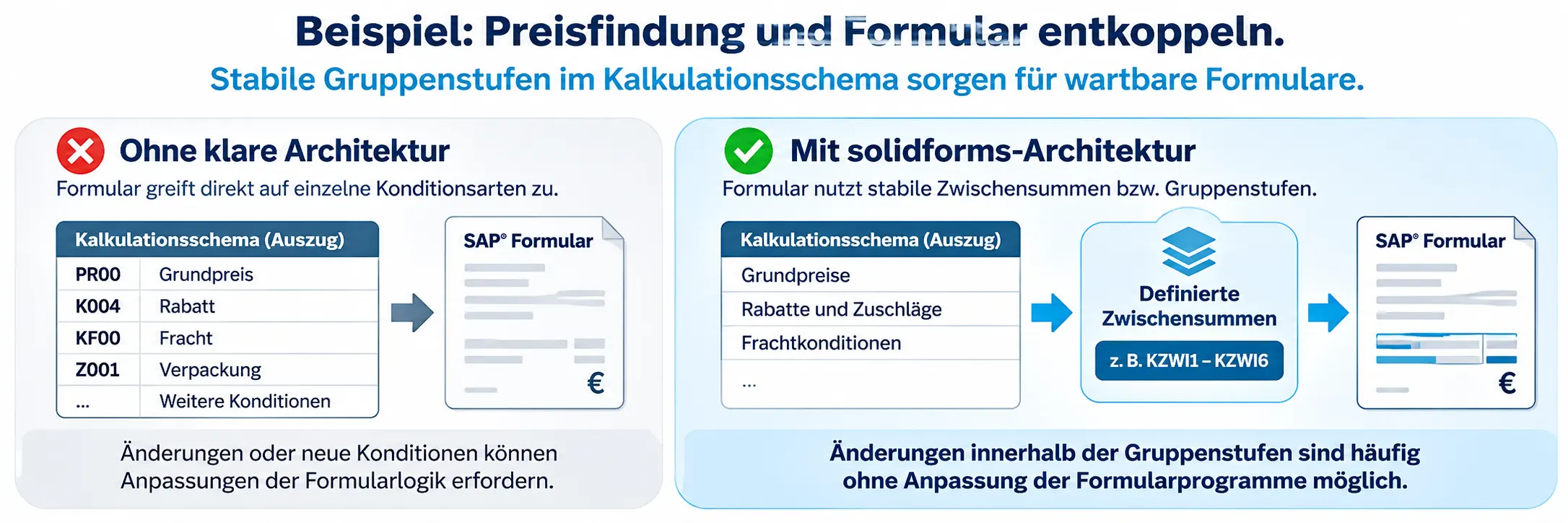
The benefit: Changes within the pricing procedure can often be made without modifying the print program – provided the agreed subtotals continue to represent the same business values.
We apply the same principle elsewhere: a stable interface between SAP® business logic, data retrieval and form layout reduces dependencies. This also applies to SAP® EWM forms, where ERP and EWM output processes need to work together.
3. Proven fixed-price form templates
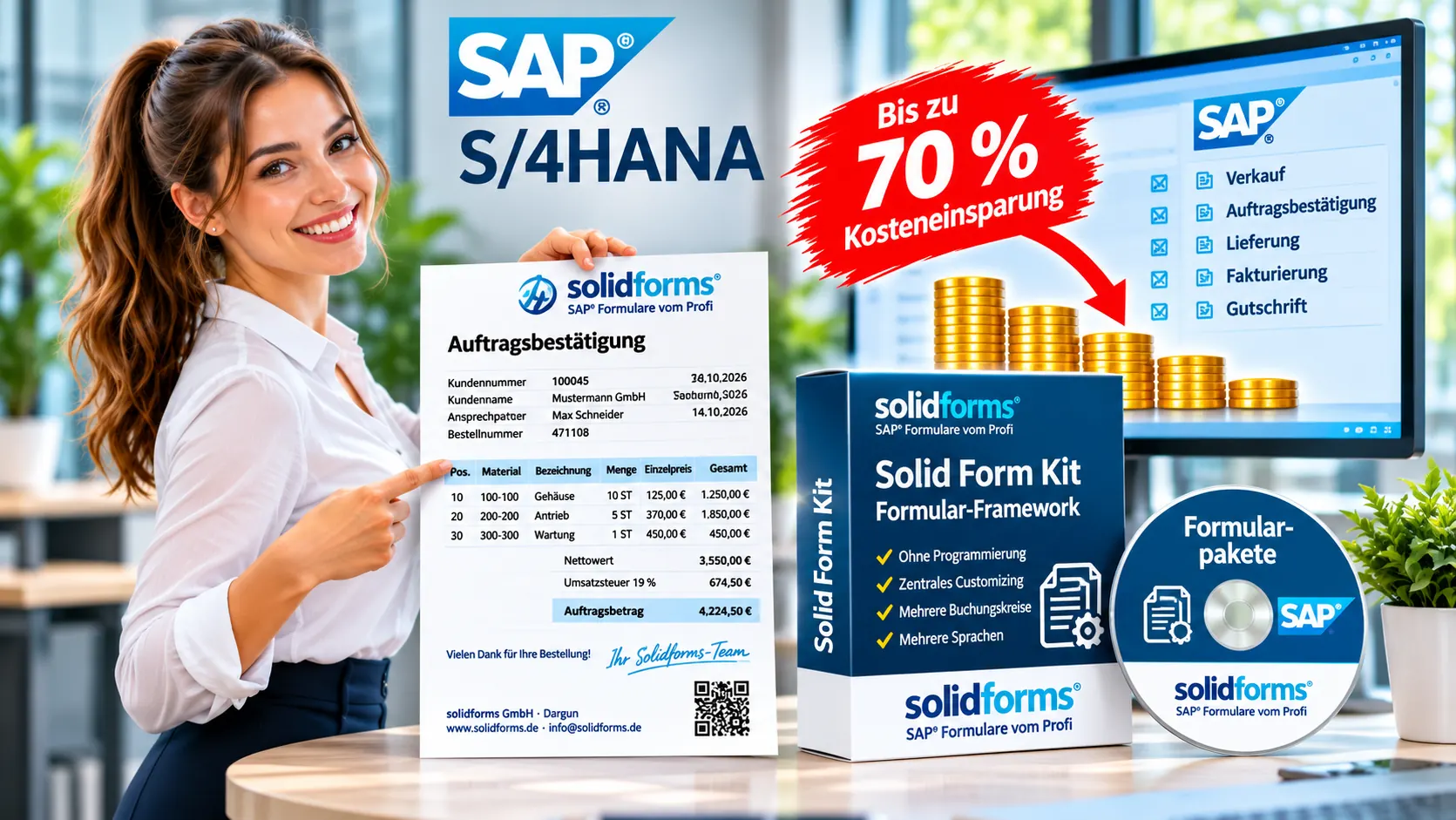
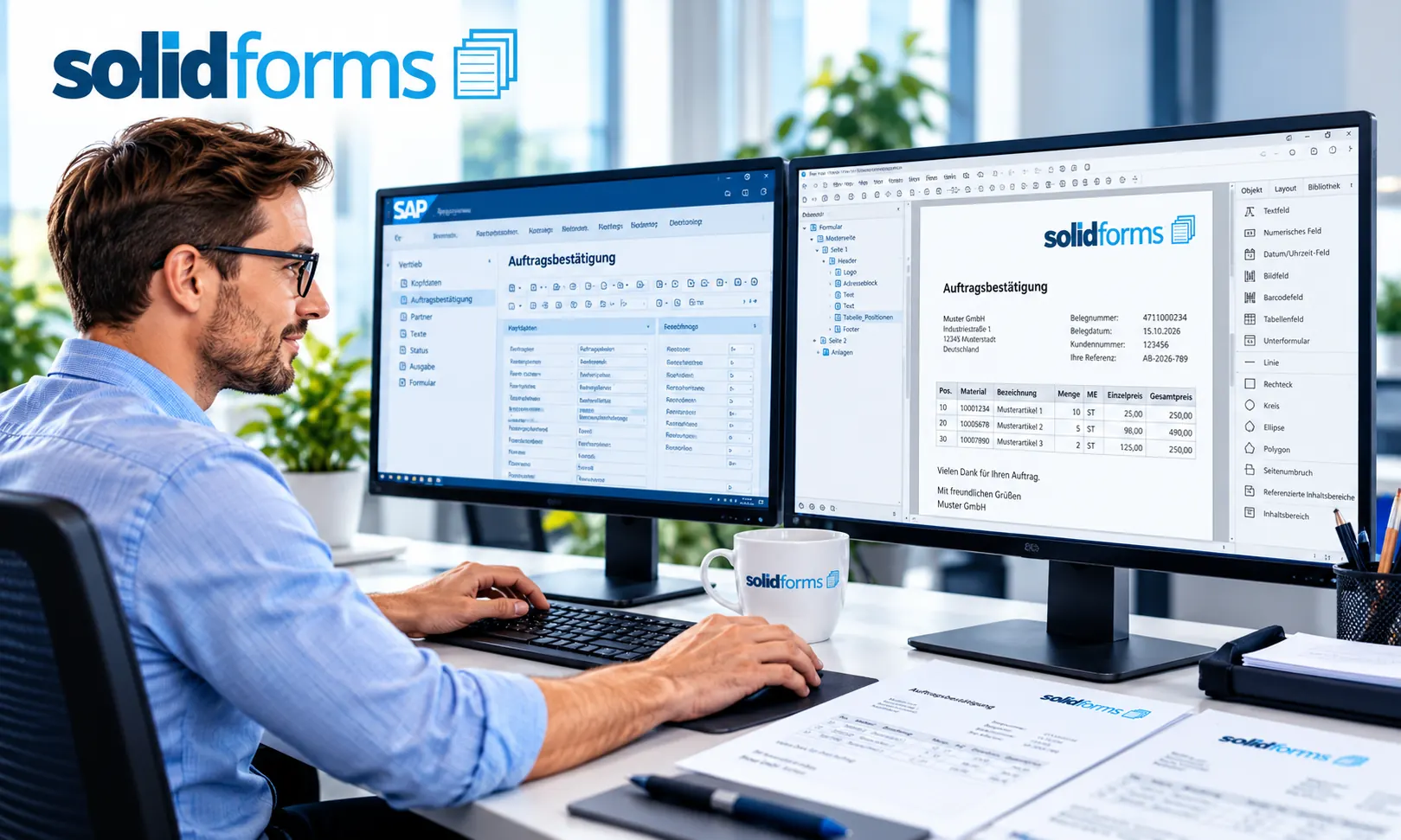
Where it makes business and technical sense, we do not start from scratch. solidforms provides proven SAP® form templates, for example for order confirmations, invoices and other business documents. These templates are offered at fixed prices.
- Faster project start with existing form foundations
- More predictable budgets through fixed template prices
- A consistent technical and visual starting point
- Adaptation to customer-specific processes and layout requirements
- Less effort for recurring standard development
Fixed prices apply to the respective templates; additional integration, customization and consulting services are agreed according to the project scope.
4. Developer workshop: solidFormKit and the forms framework
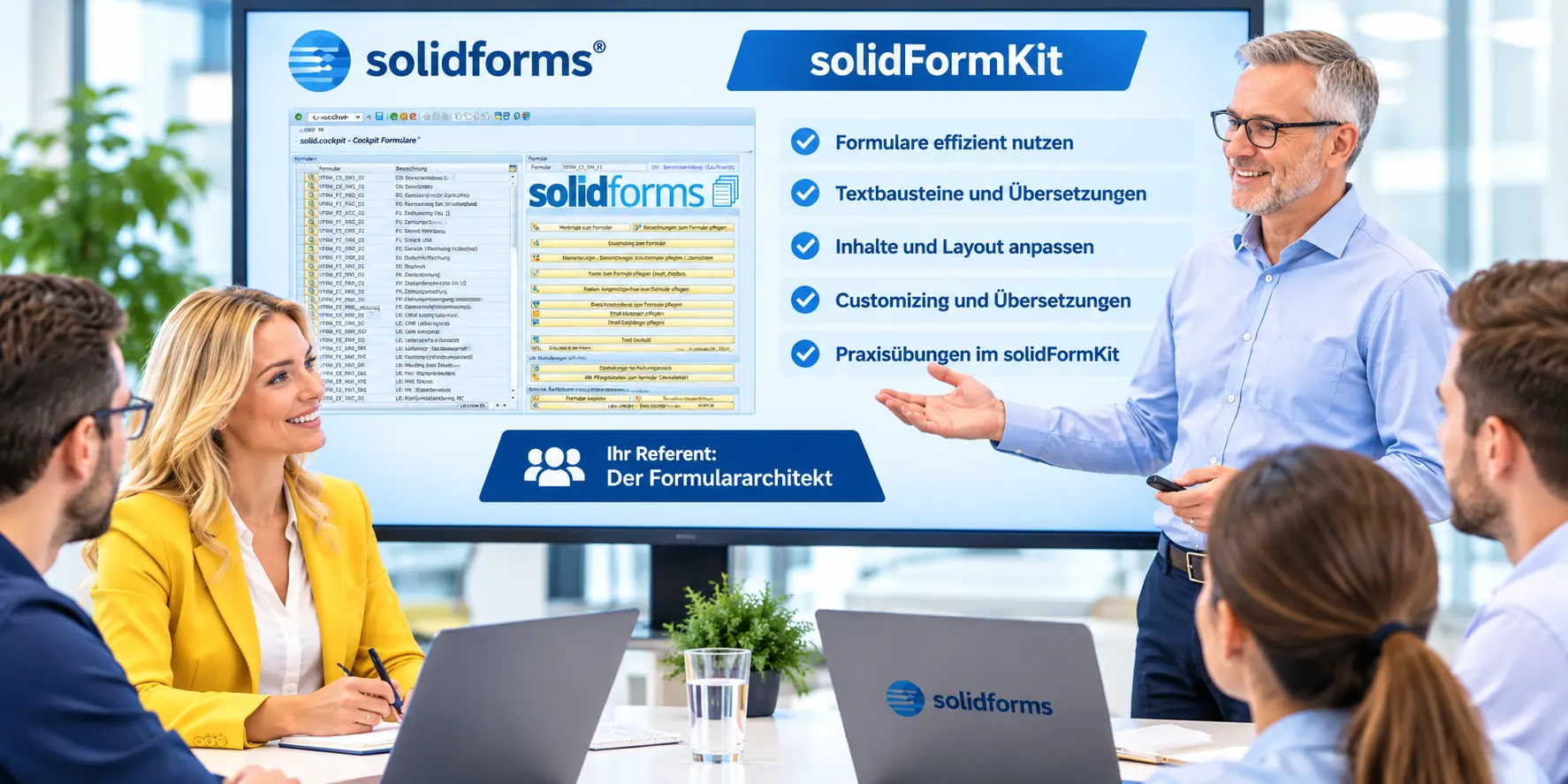
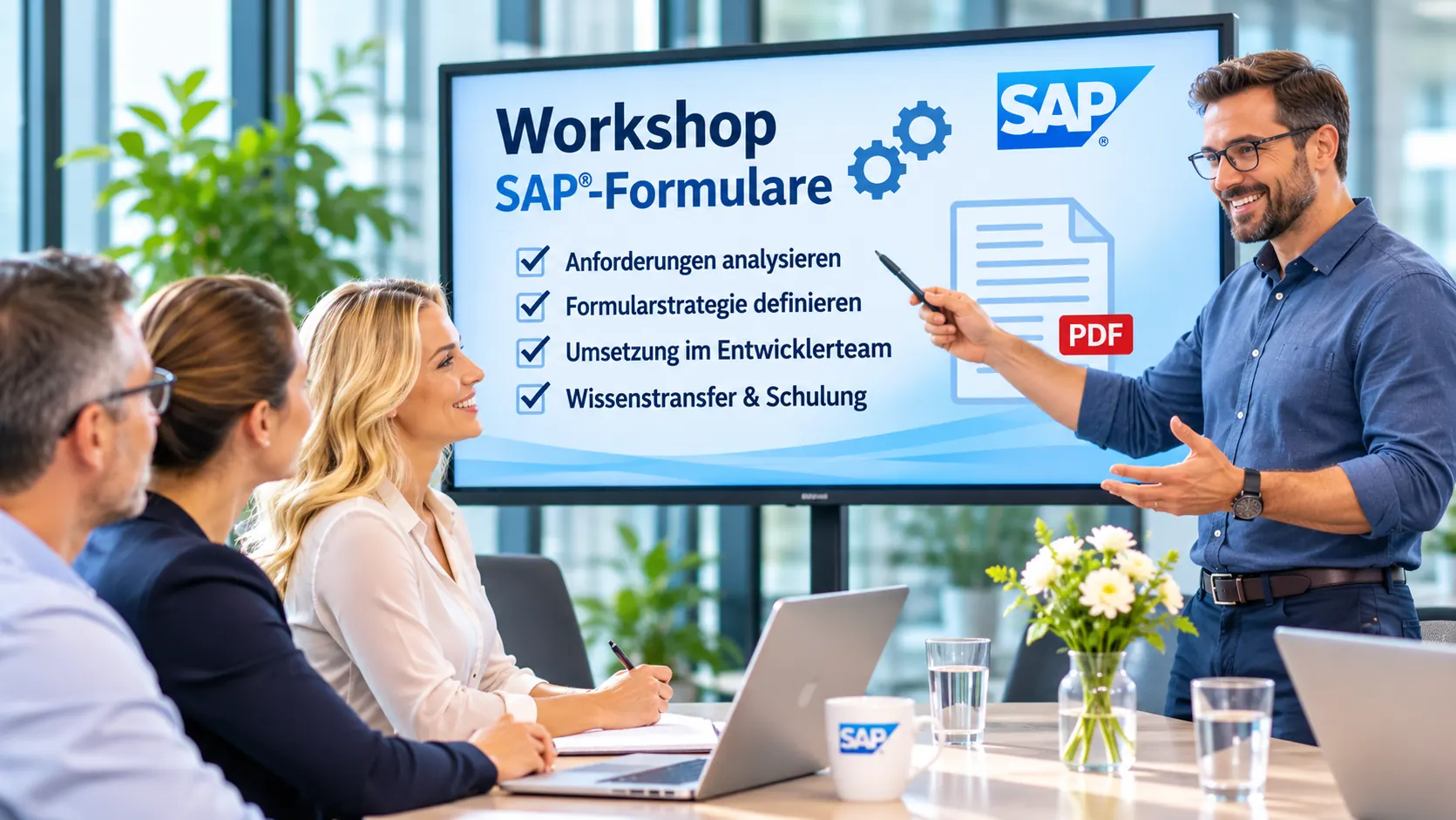
At the beginning of a project, we hold a practical workshop with the customer’s SAP® developers. Developers from an existing SAP® consulting partner can also participate. Together, we work through the architecture, tools and development standards used by solidforms.
Developer workshop topics
Structure and use of the forms framework, solidFormKit tools, separation of data retrieval and layout, reusable components, form templates, configuration, testing methods and shared development standards.
The outcome: Participating developers can efficiently develop additional forms and related programs themselves in accordance with the agreed solidforms standards. We continue to provide targeted support for complex core forms and architectural questions.
5. Actively involving existing SAP® consulting partners
Many companies already work with an SAP® consulting firm. We actively build on that relationship: the partner’s developers can attend the same workshops, use the forms framework and develop new forms and programs according to the agreed standards.
- Consistent development standards for internal and external teams
- Clear division of responsibilities between architecture and implementation
- Reusable components instead of parallel one-off solutions
- Joint reviews for demanding forms
- Less dependence on individual developers or service providers
solidforms focuses on architecture, difficult technical questions, core components and quality assurance. Implementation can be distributed among several qualified teams.
6. User workshop: maintaining form texts without programming

Form texts change constantly: notices, delivery terms, contacts, legal wording and additional text blocks need to be added, updated or removed. This should not require a forms developer every time.
In a second workshop, we train SAP® application specialists, key users and authorized business users in the relevant solidFormKit maintenance functions.
User workshop topics
Creating and editing text blocks, selectively showing or hiding text, managing language-dependent content, accounting for validity periods and organizational assignments, and testing and approving changes in a controlled way.
The outcome: Business departments can maintain ongoing text changes independently within the configured scope – without having to modify an Adobe form or ABAP program for every change.
7. Developing together – with clear roles
solidforms: architecture and complex core development
Designing the forms landscape, defining the framework, advanced data retrieval, complex core forms, technical reviews and support with critical issues.
Customer developers and consulting partners: implementation and expansion
Developing additional forms and programs based on the shared architecture, using templates, implementing defined requirements and maintaining the agreed standards.
SAP® application specialists and business users: ongoing content maintenance
Maintaining text blocks and approved form settings, performing business tests and making changes without programming where supported by the available functions.
Roles are defined together during the project. This keeps the solution manageable and retains knowledge within the company.
8. One form for many countries – but not at any cost
For international companies, we assess which differences can sensibly be handled through configuration, language-dependent texts, logos, sender details and other control parameters. This enables multiple company codes and countries to share a common form foundation.
At the same time, we avoid overloaded universal forms. When technical or business requirements differ too widely, separate templates may be the better choice. Maintainability, testing effort and long-term extensibility are what matter.

9. Our project approach in six steps
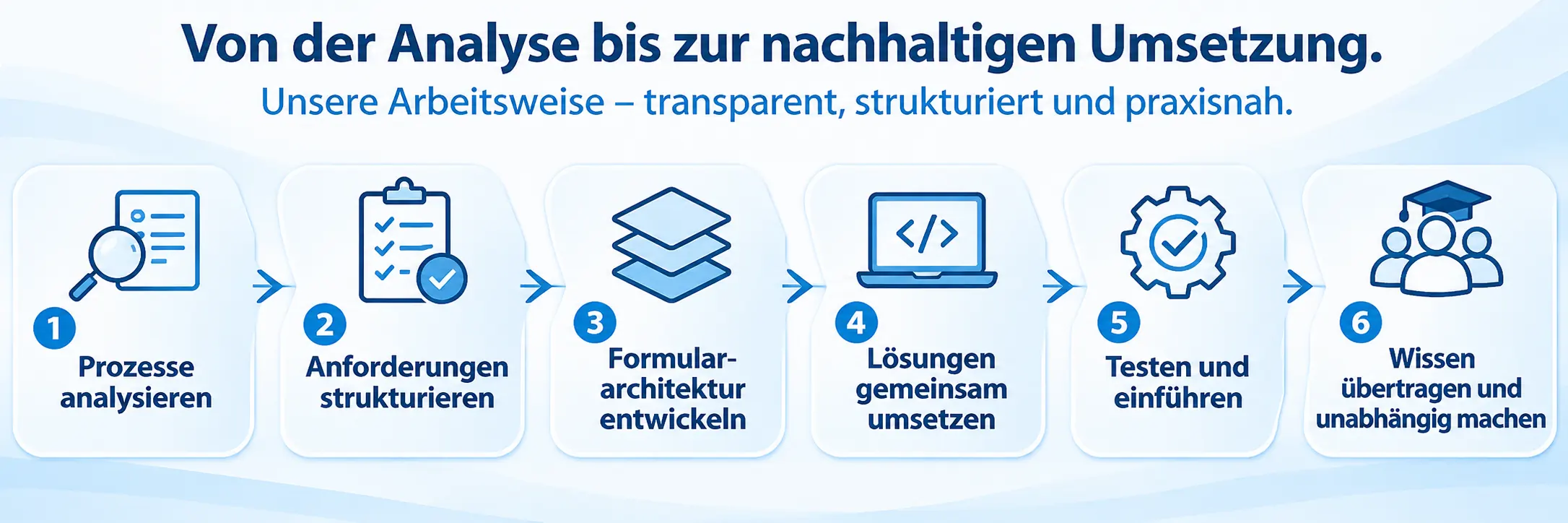
01 · Understand processes and requirements
Analyze business processes, output events, countries, languages, existing forms and responsibilities.
02 · Align architecture and SAP® configuration
Define data retrieval, pricing, subtotals, form variants and technical standards early.
03 · Provide form templates and framework
Select suitable fixed-price templates and set up solidFormKit and the shared development foundation.
04 · Train developers and consulting partners
Share tools, architectural principles and development standards in workshops; allocate responsibilities together.
05 · Implement and test forms together
Support complex core development, distribute work on additional forms and test the relevant scenarios.
06 · Empower business users and transfer knowledge
Provide text maintenance training, hand over documentation and enable independent further development.
AI-assisted SAP® form development – experience meets artificial intelligence
We also use modern AI tools to analyze existing ABAP print programs, modernize Adobe Forms and document technical dependencies. These tools help us understand complex program structures more quickly, identify opportunities for improvement and prepare development tasks more efficiently.
The forms architect’s experience remains essential: We review AI-generated results from both business and technical perspectives, make architectural decisions ourselves and ensure solution quality.
What your company gains
- Faster projects: Proven templates and clear standards reduce repetitive development work.
- Predictable costs: Fixed-price form templates provide a transparent basis for planning.
- Lower follow-on costs: A coordinated architecture can simplify changes to pricing, texts and organizational structures.
- Greater independence: In-house developers, SAP® consulting partners and business users can take on suitable tasks themselves.
- Long-term maintainability: Clear interfaces, documented standards and targeted knowledge transfer make future extensions easier.
Frequently asked questions
Does solidforms need to develop every form itself?
No. We define the architecture and standards, handle complex core tasks where needed and train the customer’s developers and consulting partner for further implementation.
Can existing SAP® consulting partners be involved?
Yes. Developers from your consulting partner can join workshops and develop forms and programs in accordance with jointly agreed solidforms standards.
What are the benefits of fixed-price form templates?
They provide a proven foundation and speed up the start of a project. Additional customer-specific adaptations and integration services are considered separately.
Why should solidforms be involved early in a project?
Because important decisions about data retrieval, pricing and form control are made during process design and configuration. Early coordination can help avoid later program changes.
Can business users change form texts without programming?
Yes, provided the relevant content and maintenance functions have been configured in solidFormKit. The user workshop explains how to use these functions safely.
Does every change to the pricing procedure require a form change?
Not necessarily. If the form uses business-defined, stable subtotals, changes within the pricing procedure can often be made without modifying the form logic.
Let’s shape your forms architecture together
Are you planning an SAP® implementation, an international rollout or the consolidation of existing forms? We support you early in the architecture and implementation phases – and equip your teams to develop and maintain the solution independently.